Showing posts with label book review. Show all posts

07 September 2017

Book Review: "Dawn of Wonder" by Jonathan Renshaw

Dawn of Wonder (The Wakening, #1)Dawn of Wonder by Jonathan Renshaw

My rating: 3 of 5 stars


I didn't realize when I bought a digital copy of Dawn of Wonder that it was so long. Deep Magic ("The E-zine of Clean Fantasy and Science Fiction") recommended it and it was on sale for a couple bucks. Even then, I wanted to sample it first. I'm not proud of this, but I became convinced the sample represented more of the novel than usual -- like, 90%. I must have ignored all the obvious indications to the contrary. The reason was because that sample -- the first nine chapters, if I remember right -- read like a complete story on its own. The protagonist was young, the villain was clear, the setting was detailed but tightly contained, etc. Earmarks of a short young adult novel.

Admittedly, it seemed odd that something marketed as epic fantasy hadn't yet introduced a single supernatural element. No magic, no fantastical races or beasts, no powerful MacGuffins. In their place was an unexpectedly realistic slave trade conflict. It took me back to a favorite book I used to borrow over and over from my middle school library: Deborah Chester's The Sign of the Owl (1981). It, too, stars a young man trying to win his father's approval and protect his corner of the world from invaders. It's definitely YA historical fiction and finishes at just over 200 pages. I unintentionally draped these same expectations on DoW and cloaked a few warning signs. For example, the damsel-in-distress trope struck me as an obvious misstep in this day and age, so obvious in fact that I assumed it was a red herring.

The sample ended at what I thought was just a few chapters shy of the ending. I'd been put through the ringer, having read most of the night. There'd been a clear story arc and most everything seemed like it could be resolved soon, with one or two deeper character developments reserved for sequels. I wanted to know how it ended, so I paid the couple bucks and kept reading, only glancing at the percentage at the bottom of my Kindle after the story didn't end when I thought it would.

It turned out I was only about 20-24% through. The plot slowed way down and I didn't pick it up again for at least a month. To be fair, that was also partially due to my lack of a regular reading schedule.

I haven't been able to find out if Renshaw ever pitched this to agents or publishers before going the self-publishing route. I give him major credit for making that work so well for him (all the positive reviews and awards), but I think I can guess their concerns. Based on my limited experience, these might include the extreme length for both a first and a YA novel (under 100K is typical; I'd guess this is closer to 150K) or the old well of tropes it draws from, like the chosen white male hero, the medieval European culture, the father-son relationship, and the aforementioned damsel-in-distress plot device. Granted, it has its roots in adventurous and moralistic fantasy worlds like Narnia and Prydain, and so do I. However, you might say Renshaw could have kept even closer to that tradition of shorter installments and less on-the-nose sermonizing.

(This is an aside that deserves a SPOILER ALERT: I read a review stating that DoW is refreshing because it avoids cliche archetypes. It explicitly gave deus ex machina as an example, the literary device in which the main characters are conveniently rescued from a rapidly downward-spiraling situation by a surprise development. Tolkien's Eagles are a fair example. To be clear, the review stated this does not happen in DoW. This confused me, as a pivotal scene in the book involves the main character overcoming his primary personal conflict, not to mention pretty downward-spiraling physical conflict, by direct intervention from not even a symbolic god, but an actual god, clearly this world's Messiah. And that's only the most obvious example. I don't fault people for liking this book, and this particular use of that trope could even be a good reason to. I'm just saying, call it like it is!)

An example of a series I've enjoyed with a young protagonist, subtle fantasy elements, and shorter installments is Joseph Delaney's The Last Apprentice series. It, too, draws from an old well of tropes, like the chosen white male hero or the aged mentor; however, it stays interesting because each book is focused on a self-contained episode in that training (a bit Harry Potter-like). My point is that there are ways to play in these traditional sandboxes while building something new and original. It's easy to see Renshaw moving in that direction, too, but the payoff may take years. SECOND SPOILER ALERT: By the end of book 1, there's something of a Schrodinger's Cat going on in the form of "Schrodinger's Fridged Female Character," in that the aforementioned damsel-in-distress could be either dead or alive, and more interestingly, still in distress or not. My guess, or hope, is alive and not distressed; that would explain Renshaw drawing this out, lending weight to the revelation that things aren't what the hero is expecting. However, I doubt I'll have the patience to find out firsthand. 

So I guess the recap is that I would have preferred this to be shorter, a bit more original, and more explicitly "fantasy." (I don't know where you fall on the TV series Gotham, but to me, a fantasy about the dawning of the fantastic is about as frustrating as a Batman story with no Batman.) It was more effort to finish than it should have been and I sensed I would have enjoyed it more twenty years ago.

Now to end with the reasons I did still finish this, i.e. what I enjoyed: The writing is strong. Renshaw is a former English teacher and seems a genuinely good guy (if the anti-bullying, anti-slave trading agenda both here and on his web site are any indication). He has a knack for natural yet original similes. The main character's complex relationship with his father and the conflict that creates is unusually real and poignant. Rare supernatural moments that have no right to be scary still are simply because they aren't taken for granted. There are several interesting female characters, one of whom is a person of color. The slow build means the conflict resolutions are all fairly satisfying. And finally, the messages of hard work, hope, and forgiveness make this something I might recommend to my teen kids. That way, they can give me the shorthand version of the sequel!

06 February 2015

"Seventh Son": Book vs. Movie

Legendary Pictures
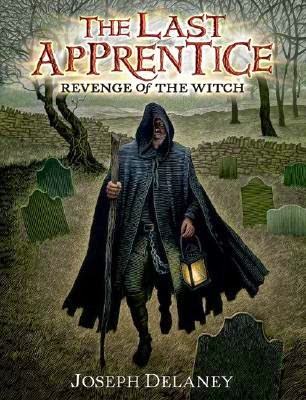
Back in early December, my family was standing in line at the movie theaters when a trailer for Seventh Son played on the lobby big screen. Intrigued, my son wanted to know more about it. I knew only a little, having noticed a while back that its release date was rescheduled several times. That night I looked it up, found out it was based on a book (naturally), and downloaded a sample for my Kindle. It hooked me right away. I purchased the full book, pictured below, and finished it that night.

The movie arrived in theaters today, but the critic consensus is not good: an embarrassing 11% on Rotten Tomatoes. (This weekend's other epic genre film, Jupiter Ascending, has a 22%. Both are far outdone by - wait for it - The SpongeBob Movie, at 74%.) Between the terrifying book it's based on, the amazing cast, and the exciting trailer, one might wonder how the film could be that bad...release date warning signs notwithstanding.

This isn't a review of the film, as I haven't seen it yet. The thing is, as soon as I compared The Last Apprentice: Revenge of the Witch (otherwise known as The Spook's Apprentice) with the trailer that exposed me to it, I knew the filmmakers had taken huge liberties. Granted, I have yet to read the other twelve books in Joseph Delaney's YA dark fantasy series, so I wouldn't know if the movie draws on them, too. While it stands to reason that an adaptation will make the story and characters its own - and watering down a book for movie audiences is practically axiomatic today - it's concerning if it repels people from the source material instead of attracting them to it. The trailer worked on me and my son, but maybe the full movie would have the opposite effect. While not meant to discourage anyone from seeing the movie (which, again, I haven't), here are three important differences hopefully proving the book is worth your time:

20 August 2014

"Ready Player One" Review

Ready Player OneReady Player One by Ernest Cline

My rating: 3 of 5 stars

A revival of '80s geek culture has been going on for a while now, especially as evidenced by (maybe caused by?) the dominance of superhero movies and the rebooting of sci-fi franchises. What's more, these often make more '80s references in the form of "easter eggs" and in-jokes. Some are subtle and surprising (Tony Stark catches a SHIELD officer playing Galaga) while others are the sum total of the appeal (practically every other line in Guardians of the Galaxy). Ready Player One author Ernest Cline tapped into this trend in a big way, admittedly slightly earlier than either of those examples (2011).

The thing is, the '80s "wink winks" are starting to wear on me. I don't know if it's because I only really remember half of the '80s, having been born at the first part of that decade, or because the references are becoming a lazy shortcut to humor and audience appreciation.

Ready Player One is a book full of those forced references. The difference is that these aren't usually played for humor. They're at the heart of the plot and setting because both were created by someone even more obsessed with '80s culture than Star-Lord. Sometimes this works really well. Other times it's like reading Wikipedia. For chapters on end. Especially in the beginning.

Despite how it sounds, I enjoyed this book and felt completely engrossed in the plot - especially once it actually got going. It worked on me the way The Big Bang Theory does (and coincidentally, both feature Wil Wheaton as himself). Unfortunately, said sitcom tends to divide audiences, offending some for its perpetuation of geek and other stereotypes. This book has some of that going on, too. Occasionally Cline tries to balance the pure escapism by challenging some of those stereotypes (and pure escapism itself), but these moments feel a little clumsy and disingenuous. See the SPOILERS section below for examples.

That said, this book is really more safe than offensive or controversial, focused more on nostalgia than originality. The cover blurb calls it a cross between Willy Wonka and The Matrix, and it's startling how accurate that is. All its really fun elements are not just borrowed from other games and movies; they are those games and movies, so you can only enjoy it as much as you enjoy watching someone else play Pac Man or watch WarGames. I spent much of the book distracted by the knowledge that this is being made into a movie, wondering how they will possibly get the rights to all those properties or recreate them in a way that doesn't just look like a supercut of unrelated characters and settings. I predict the movie will fall short in its inevitable comparison to Wreck-it Ralph, especially if it keeps the content that prevents it from being appropriate for kids. It will probably be more at home alongside lesser known but successful teen action/comedies like Scott Pilgrim vs. the World.

The thing is, Ready Player One knows what it is, which is every gamer's dream: a conflict that can only be overcome by being good at games and knowing otherwise useless trivia! For as long as such a premise can possibly work, this one does.

02 February 2014

Fahrenheit 451


Fahrenheit 451 by Ray Bradbury
My rating: 5 of 5 stars

I can't believe I waited until I was 31 to read this. Then again, maybe I wouldn't have appreciated it as much as I did. Below were some quotes I saved and annotated:
"Now let’s take up the minorities in our civilization, shall we? Bigger the population, the more minorities. Don’t step on the toes of the dog-lovers, the cat-lovers, doctors, lawyers, merchants, chiefs, Mormons, Baptists, Unitarians, second-generation Chinese, Swedes, Italians, Germans, Texans, Brooklynites, Irishmen, people from Oregon or Mexico. The people in this book, this play, this TV serial are not meant to represent any actual painters, cartographers, mechanics anywhere. The bigger your market, Montag, the less you handle controversy, remember that!" –Beatty, toward the end of “The Hearth and the Salamander”

Judging from the other “minorities” Bradbury put in this list, I doubt the inclusion of Mormons was much more than arbitrary. Still, I find it kind of funny, because, as a white male Mormon, I doubt that throwing my name out there as a minority would win much sympathy. If anything, it’s Mormons that some minorities feel threatened by, and whose perspective no book, play, or TV serial is worried about representing correctly.

20 July 2012

About My 'Wayne of Gotham' Book Review


My Wayne of Gotham book review came out today, which is almost a month after I wrote it.  It's somewhat strangely edited, so if you're interested, I wrote a new one on its product page at Amazon.com.  (There's also one at Goodreads).

As a final note, and after having just watched last night's midnight showing of The Dark Knight Rises, I can't help but acknowledge that the film and Hickman's book draw from some of the same comic book source material--in particular, the ending to Frank Miller's The Dark Knight Returns.  However, I also feel that Nolan's film retold this material much more satisfyingly, making a comparison between the two feel somewhat silly.

UPDATE: My fondness for The Dark Knight Rises finally caved after a few repeat viewings and I decided it's for similar reasons. In other words, it actually doesn't seem that silly to compare this book and that film. And to be fair to both, I'm realizing - with the recent release of The Dark Knight Returns as animated movies in two parts - that said graphic novel is not actually my favorite Batman story, either.