Showing posts with label fantasy. Show all posts

03 July 2024

"The Direct Approach"


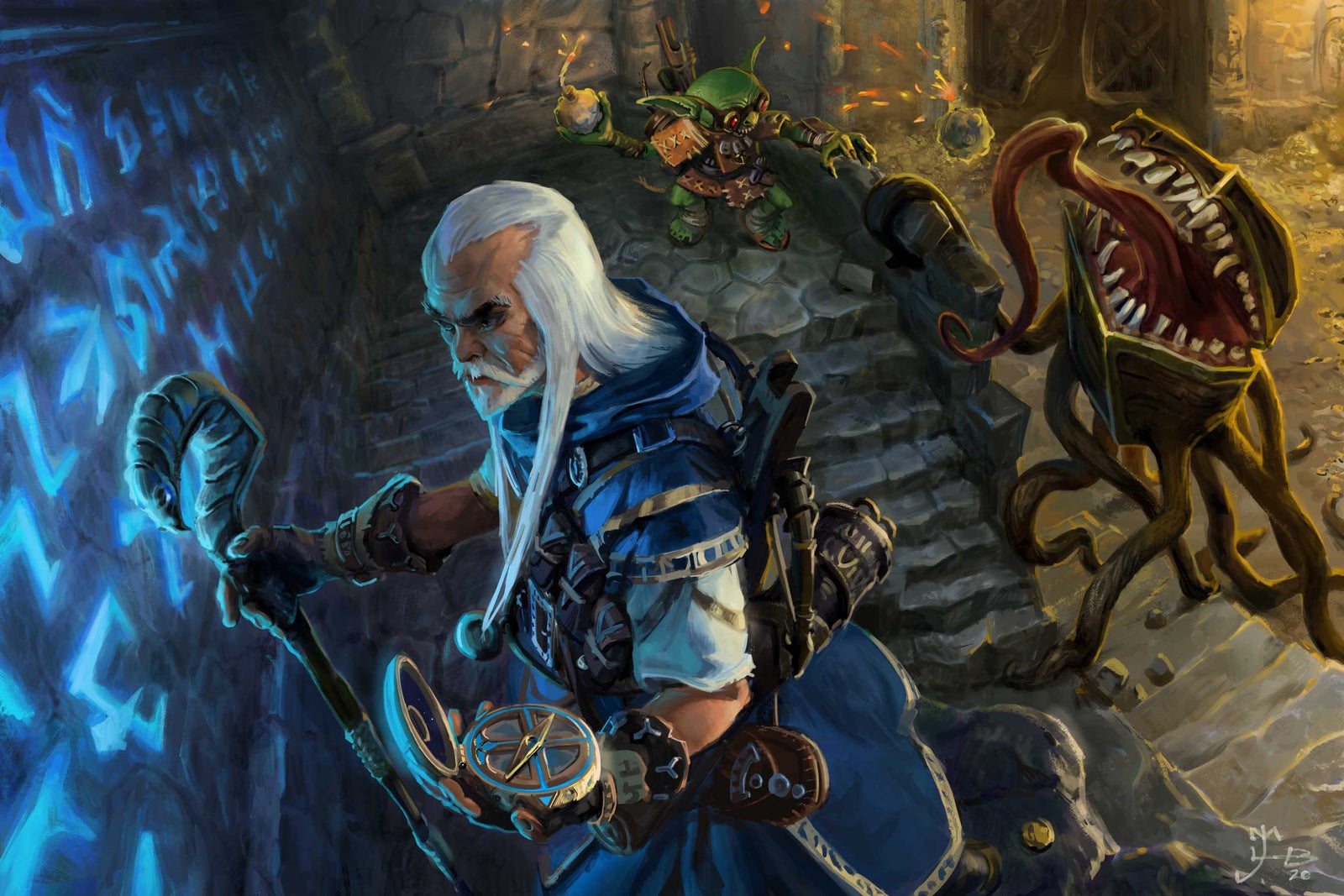
My first contribution to the Pathfinder RPG was a piece of short fiction called "The Drawings on the Wall," featuring the Iconic characters Ezren and Fumbus. I recently had the opportunity to write a second story about two different Iconics, namely Jirelle the swashbuckler and Sajan the monk. Their playable classes appear in the Pathfinder Player Core 2, as does the above illustration of the "Water Sprint" feat by Alexander Nanitchkov.

This was another fun one to work on. Read the story here!

14 September 2021

Last Dance of the Sugar Golem


There's still time to back Upon a Thrice Time, a fairy tale anthology which includes my story "Last Dance of the Sugar Golem."

This started as an entry to Apex Magazine's holiday-themed flash fiction contest in 2015. A retelling of "The Nutcracker and the Mouse King" by E. T. A. Hoffmann (1816), it didn't win, but I liked it well enough to keep tinkering with it. Though never a big fan of the play, I had read Hoffmann's source material as part of my college study of old/classic second-world fantasy literature and really liked the similarities between Marie's visit to the Candyland-like doll kingdom and Margaret Cavendish's The Blazing World (1666).

My story went through several revisions and rejections leading up to 2020, when I learned about a call for submissions to Upon a Once Time. They were looking for fairy tale mashups--two stories combined and retold as fantasy, sci-fi, noir, etc. This helped me realize that my sugar golem story drew on not just "The Nutcracker," but also "Mr. Fox," Joseph Jacobs's version of the Grimm Brothers' "The Robber Bridegroom." A cousin recited "Mr. Fox" to me when I was little and I've never forgotten the grisly plot and haunting imagery. It took very little work to make its influence more overt, but a bigger revision was switching to a first-person narrative. I submitted it for Upon a Twice Time, the second volume in this series, and was accepted for the third volume.

You can visit the Kickstarter page here.

Cover art by Jana Heidersdorf.

17 September 2020

"The Drawings on the Wall"


I got back into tabletop RPGs in 2006 when my sons and I started playing Pathfinder (1st edition). We loved Wayne Reynolds's artwork and the enormity of character options and published adventures. We plan to dive into 2nd edition with the upcoming Beginner Box, so I was thrilled by the opportunity to contribute a piece of web fiction to the Paizo Blog. The story prompt was the above illustration of Iconic characters Ezren and Fumbus by Juan Miguel Lopez Baraea, found in Pathfinder Lost Omens: Pathfinder Society Guide.

Read the story here!

07 September 2017

Book Review: "Dawn of Wonder" by Jonathan Renshaw

Dawn of Wonder (The Wakening, #1)Dawn of Wonder by Jonathan Renshaw

My rating: 3 of 5 stars


I didn't realize when I bought a digital copy of Dawn of Wonder that it was so long. Deep Magic ("The E-zine of Clean Fantasy and Science Fiction") recommended it and it was on sale for a couple bucks. Even then, I wanted to sample it first. I'm not proud of this, but I became convinced the sample represented more of the novel than usual -- like, 90%. I must have ignored all the obvious indications to the contrary. The reason was because that sample -- the first nine chapters, if I remember right -- read like a complete story on its own. The protagonist was young, the villain was clear, the setting was detailed but tightly contained, etc. Earmarks of a short young adult novel.

Admittedly, it seemed odd that something marketed as epic fantasy hadn't yet introduced a single supernatural element. No magic, no fantastical races or beasts, no powerful MacGuffins. In their place was an unexpectedly realistic slave trade conflict. It took me back to a favorite book I used to borrow over and over from my middle school library: Deborah Chester's The Sign of the Owl (1981). It, too, stars a young man trying to win his father's approval and protect his corner of the world from invaders. It's definitely YA historical fiction and finishes at just over 200 pages. I unintentionally draped these same expectations on DoW and cloaked a few warning signs. For example, the damsel-in-distress trope struck me as an obvious misstep in this day and age, so obvious in fact that I assumed it was a red herring.

The sample ended at what I thought was just a few chapters shy of the ending. I'd been put through the ringer, having read most of the night. There'd been a clear story arc and most everything seemed like it could be resolved soon, with one or two deeper character developments reserved for sequels. I wanted to know how it ended, so I paid the couple bucks and kept reading, only glancing at the percentage at the bottom of my Kindle after the story didn't end when I thought it would.

It turned out I was only about 20-24% through. The plot slowed way down and I didn't pick it up again for at least a month. To be fair, that was also partially due to my lack of a regular reading schedule.

I haven't been able to find out if Renshaw ever pitched this to agents or publishers before going the self-publishing route. I give him major credit for making that work so well for him (all the positive reviews and awards), but I think I can guess their concerns. Based on my limited experience, these might include the extreme length for both a first and a YA novel (under 100K is typical; I'd guess this is closer to 150K) or the old well of tropes it draws from, like the chosen white male hero, the medieval European culture, the father-son relationship, and the aforementioned damsel-in-distress plot device. Granted, it has its roots in adventurous and moralistic fantasy worlds like Narnia and Prydain, and so do I. However, you might say Renshaw could have kept even closer to that tradition of shorter installments and less on-the-nose sermonizing.

(This is an aside that deserves a SPOILER ALERT: I read a review stating that DoW is refreshing because it avoids cliche archetypes. It explicitly gave deus ex machina as an example, the literary device in which the main characters are conveniently rescued from a rapidly downward-spiraling situation by a surprise development. Tolkien's Eagles are a fair example. To be clear, the review stated this does not happen in DoW. This confused me, as a pivotal scene in the book involves the main character overcoming his primary personal conflict, not to mention pretty downward-spiraling physical conflict, by direct intervention from not even a symbolic god, but an actual god, clearly this world's Messiah. And that's only the most obvious example. I don't fault people for liking this book, and this particular use of that trope could even be a good reason to. I'm just saying, call it like it is!)

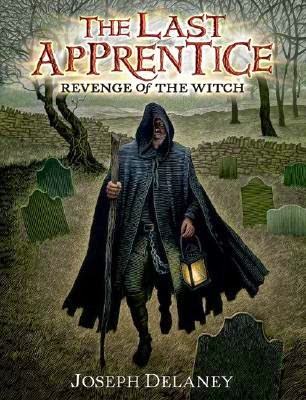
An example of a series I've enjoyed with a young protagonist, subtle fantasy elements, and shorter installments is Joseph Delaney's The Last Apprentice series. It, too, draws from an old well of tropes, like the chosen white male hero or the aged mentor; however, it stays interesting because each book is focused on a self-contained episode in that training (a bit Harry Potter-like). My point is that there are ways to play in these traditional sandboxes while building something new and original. It's easy to see Renshaw moving in that direction, too, but the payoff may take years. SECOND SPOILER ALERT: By the end of book 1, there's something of a Schrodinger's Cat going on in the form of "Schrodinger's Fridged Female Character," in that the aforementioned damsel-in-distress could be either dead or alive, and more interestingly, still in distress or not. My guess, or hope, is alive and not distressed; that would explain Renshaw drawing this out, lending weight to the revelation that things aren't what the hero is expecting. However, I doubt I'll have the patience to find out firsthand. 

So I guess the recap is that I would have preferred this to be shorter, a bit more original, and more explicitly "fantasy." (I don't know where you fall on the TV series Gotham, but to me, a fantasy about the dawning of the fantastic is about as frustrating as a Batman story with no Batman.) It was more effort to finish than it should have been and I sensed I would have enjoyed it more twenty years ago.

Now to end with the reasons I did still finish this, i.e. what I enjoyed: The writing is strong. Renshaw is a former English teacher and seems a genuinely good guy (if the anti-bullying, anti-slave trading agenda both here and on his web site are any indication). He has a knack for natural yet original similes. The main character's complex relationship with his father and the conflict that creates is unusually real and poignant. Rare supernatural moments that have no right to be scary still are simply because they aren't taken for granted. There are several interesting female characters, one of whom is a person of color. The slow build means the conflict resolutions are all fairly satisfying. And finally, the messages of hard work, hope, and forgiveness make this something I might recommend to my teen kids. That way, they can give me the shorthand version of the sequel!

22 June 2016

Dungeons & Dragons & Drawing


Once upon a time Often upon fifteen+ years ago, I played that little role-playing game called Dungeons and Dragons. As you'll notice in the "Labels" section on the right, I've mentioned D&D here before, plus in a short product description for Nerdy With Children a few years back. I owe my cousins for introducing it to me, because I loved it, and used it (like many people have) to build storytelling skills, plan and write novels, and enjoy a whole lot of adventures with my friends. I guess you could say this is my attempt to pay it forward!

I've mentioned in earlier posts that, after a long hiatus from dungeon-delving games, I eventually found Descent 2nd Edition. I'm still a rabid Descent fan, which I value for its artwork, its relative simplicity (compared to RPGs, which it isn't), and its short preparation time. In other words, I've appreciated not having to fill what I remember as the very time-consuming role of "Dungeon Master."

However, a few months ago, I discovered a Humble Bundle for an RPG called Pathfinder, which is D&D 3rd edition's Open License rule system re-branded by Paizo Publishing. I wasn't eager to jump back into tabletop RPGs; if anything, I avoided it. However, the bundle included digital copies of hundreds of dollars worth of rulebooks and quest modules for less than $20, which was hard to ignore. I mentioned it to a father and son at my church as well as my two boys, and they all convinced me to go for it.

01 October 2015

Descent 2nd Edition Painted Miniatures, Part 5

In Part 4 I explained what Hero and Monster Collections are and shared the miniatures (painted by my brother) from the first three: Oath of the Outcast, Crown of Destiny, and Crusade of the Forgotten. Though Fantasy Flight Games has released and announced even more expansions, the following completes my current collection. These come from Guardians of Deephall and Visions of Dawn. They were finished in August but I've been slow to post them. Enjoy!

HEROES

Mordrog (Orc Warrior)

Lord Hawthorne (Human Warrior)

Sahla (Human Healer)

Silhouette (Human Scout)
MONSTERS

Crypt dragons

Wendigos

Dark priests

11 August 2015

Do You Want To Build a Scarecrow?

Credit: solaroid by way of TV Tropes
Today's mail brought my copy of Scarecrow, a themed speculative fiction anthology edited by Rhonda Parrish and published by World Weaver Press. (See the cover here; you can order it here or from Amazon.) Along with work by Devil's Arithmetic author Jane Yolen and others I'm excited to read is my short story "The Straw Samurai," which was inspired in part by the above illustration of a tengu. A tengu is a Japanese mythological creature, and my original intent was to write a story about one for the companion anthology, Corvidae, to be continued in a sequel for Scarecrow. Because I had this idea just three weeks before the submission deadline (Halloween, 2014), I had to blend it into a single, standalone story that I barely finished on time. As expected, it deals with both tengu (crow-people) and a scarecrow, but it was chosen for the latter theme.

Here's a quick blurb:
Okamiko is a lonely human girl in a land of Monster villages. She wanders between these cow-people and bird-people and dog-people, struggling to find where she belongs...until a family of chough-children want her only friend - a supposedly magical stick of bamboo - in exchange for a straw samurai.
 Without giving anything significant away, I can also tell you:

  • the story is a retelling of the Japanese folktale "The Tengu's Magic Cloak"
  • it features anthropomorphic animals, or mutants - a subject I devoted a lot of attention to in this post
  • even though the corvidae called choughs (pronounced "chuff") aren't native to Japan, I made my tengu red-billed chough-people because of the similarity in appearance
  • it represents my fascination with the subject of supernatural transformation, as explained here
  • the main character was inspired by both Ponyo (from the Miyazaki movie, itself a retelling of The Little Mermaid) and my daughter Greta
  • I've written two novels set in this same universe of retold myths and legends, and while several excerpts were shortlisted and one was an honorable mention in the Writers of the Future Contest, this is the first story set in that universe to see publication
  • it is also the first to be written specifically for a themed call for submissions
It's not a terribly long story, so that's probably more than sufficient preamble. I hope you'll take the chance to read it!

02 August 2015

Descent 2nd Edition Painted Miniatures, Part 4

Parts 1, 2, and 3 in this series of posts have focused on heroes and monsters exclusive to the second edition of Descent. I never played the first edition (which was apparently quite a bit longer and more complicated), so I was excited when Fantasy Flight Games first started porting its heroes and monsters over to second edition in Hero and Monster Collections. Previously, players who owned the first edition miniatures could still use them in second edition if they purchased the conversion kit. The Hero and Monster Collections are geared more toward players like me with no first edition miniatures. Each one contains four heroes and three monster groups, all with new sculpts and artwork (much better if you ask me). As a bonus, each also contains two new quests playable by themselves or as side missions in a regular campaign. There are currently five collections available with a sixth on the way. In this post I'll share the first three: Oath of the Outcast, Crown of Destiny, and Crusade of the Forgotten. As usual, my brother painted all the figures and took all the pics.


HEROES


Trenloe the Strong (Human Warrior)

Laurel of Bloodwood (Elf Scout)

Shiver (Elf Mage)

Elder Mok (Orc Healer)
MONSTERS

Beastmen

Bane spiders

Razorwings

30 July 2015

"Scarecrow" Cover Reveal


Behold the official cover of Scarecrow, a speculative fiction anthology that includes my short story, "The Straw Samurai." The anthology is edited by Rhonda Parrish and published by World Weaver Press. The official reveal can be found here along with a Goodreads giveaway, but I thought I'd share portions of the press release below.

14 July 2015

Descent 2nd Edition Painted Miniatures, Part 3

In this third post showing my painted Descent: Second Edition miniatures, I'll focus on both big box expansion: Labyrinth of Ruin and Shadow of Nerekhall. Each contains four new heroes and classes, four new monster groups, several new lieutenants, new quests playable alone or in a full campaign, and new game mechanics. As mentioned in Part 1 and Part 2, the paint jobs and pics were done by my brother, whose Etsy store of various geek-related crafts can be found here.

Labyrinth of Ruin

HEROES

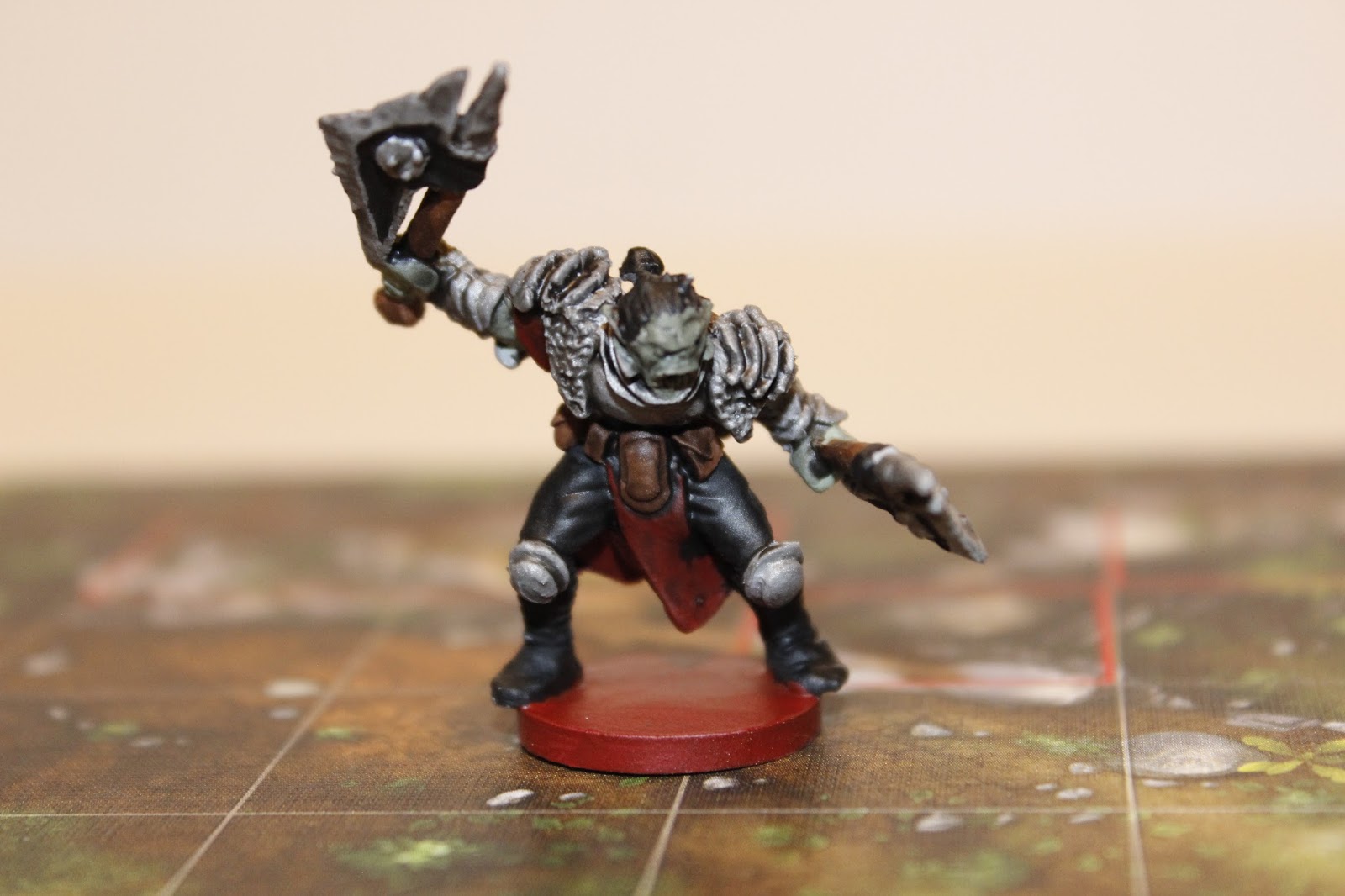
Pathfinder Durik (Orc Warrior)
Dezra the Vile (Human Mage)
Ulma Grimstone (Dwarf Healer)
Logan Lashley (Human Scout)
MONSTERS

Goblin witchers
Volucrix reavers
Carrion drakes
Arachyura

LIEUTENANTS / ALLIES

One of the new mechanics introduced in this campaign is the use of allies. Depending on which path the heroes choose, they will receive assistance from either a healer or a scout, with an opportunity to switch later on. Whichever is spurned then falls under the overlord's sway and becomes an evil lieutenant. As with the lieutenants in other expansions, these are represented by picture tokens unless you buy the Lieutenant Packs, which in this case include both versions of the character. The ally version includes a hero sheet, making them playable as heroes in any but this campaign. Both are pictured below, along with the transformed version of Ariad (I don't have the other).


Serena (Human Healer)
(Left: lieutenant; right: ally/hero.)
Raythen (Dwarf Scout)
(Left: ally/hero; right: lieutenant.)
Queen Ariad
(spider form of the campaign's big baddy)

04 July 2015

Descent 2nd Edition Painted Miniatures, Part 2

Continuing the series of posts showcasing my painted Descent: Second Edition miniatures, here are the heroes and monsters from two of the all three available small-box expansions. Half the size of full-box expansions, each contains two new heroes and classes, two new monster groups, one new lieutenant, new quests playable alone or as a mini-campaign, and new game mechanics. I don't have the third, Manor of Ravens, but here's Lair of the Wyrm, and The Trollfens, and Manor of Ravens. As mentioned in Part 1, the paint jobs and pics were done by my brother.

Lair of the Wyrm

HEROES

Reynhart the Worthy (Human Warrior)
High Mage Quellen (Elf Mage)
MONSTERS

Hybrid sentinels

Fire imps
LIEUTENANT

Valyndra

19 June 2015

Descent 2nd Edition Painted Miniatures, Part 1


For a long time I looked for a dungeon-delving board game the likes of Milton Bradley's HeroQuest, which I had largely ignored as a teenager in favor of more complex RPGs like Dungeons and Dragons. As an adult and father, I wanted something easier to teach my kids and to play in a single sitting, with more emphasis on miniatures than role-playing. Unfortunately, HeroQuest is outdated, and maybe slightly too simplistic. After checking out some of D&D's own beginner games and others like it, I decided Descent: Journeys in the Dark Second Edition was the best combination of quality, quantity, and compelling rules. Though not perfect and certainly a bit more complicated than advertised, it has been an extremely enjoyable hobby. I've been playing for a few years now, primarily with a group of friends in a monthly game night, but also with my wife and kids.

One thing I knew I'd never do, though, is paint the little plastic miniatures, which is otherwise a time-honored tradition in this arena. I just wasn't committed enough and doubted my artistic ability. Then my brother Michael - one of the regular players in my monthly group - acquired Imperial Assault, a Star Wars-themed version of Descent made by the same company (Fantasy Flight Games). He quickly painted his miniatures, and realizing he had a knack for it, offered to paint some of mine, too. Since I own the base game of Descent and most of the expansions, I doubted he'd be able to paint very many of them. Instead, he has now nearly finished my current collection, and the results have been phenomenal!

I never could have guessed how much it adds to the experience to play with painted figures. Some might wish they came painted already, but I've thoroughly enjoyed waiting to see my brother's latest work. Though I've been a bit stingy about sticking to the artwork, he has added just enough creative touches and stylistic choices for these to bear his signature, which is way more meaningful to me than figures painted in a factory. So naturally, I have to show them off! I can't do it all in one post, so to start out, here are the figures from the base game campaign, "The Shadow Rune." Michael took the pictures, too, but stood them on Imperial Assault map tiles because he didn't have access to mine (they look identical from a distance).

18 April 2015

Dungeon Roll Review

Credit: playtmg.com
Name: Dungeon Roll (I often call it "Dungeon Dice" by accident...because, you know, alliteration.)
Developer: Tasty Minstrel Games
# of Players: 1-4 (but see below)
Time: 15-30 minutes (but see below)
Ages: 8+ (My 7-year-old has played just fine.)

I became interested in this game after viewing the Watch It Played YouTube video (which is also very helpful for understanding the rules). My kids saw it, too, and said "We have got to get that game!" To us, the appeal was a dungeon-delving experience distilled to a simple custom-sided dice game playable in less than an hour.

We enjoyed our first play-through quite a bit, but it's usually not our first choice for family game night. It works great for 1-2 players because it moves quickly and there's always something to do. After that, there will always be one or more players doing nothing but waiting for someone's dungeon delve to finish - which can take 10-15 minutes if they're slow deciding how to spend their die rolls.

06 February 2015

"Seventh Son": Book vs. Movie

Legendary Pictures
Back in early December, my family was standing in line at the movie theaters when a trailer for Seventh Son played on the lobby big screen. Intrigued, my son wanted to know more about it. I knew only a little, having noticed a while back that its release date was rescheduled several times. That night I looked it up, found out it was based on a book (naturally), and downloaded a sample for my Kindle. It hooked me right away. I purchased the full book, pictured below, and finished it that night.

The movie arrived in theaters today, but the critic consensus is not good: an embarrassing 11% on Rotten Tomatoes. (This weekend's other epic genre film, Jupiter Ascending, has a 22%. Both are far outdone by - wait for it - The SpongeBob Movie, at 74%.) Between the terrifying book it's based on, the amazing cast, and the exciting trailer, one might wonder how the film could be that bad...release date warning signs notwithstanding.

This isn't a review of the film, as I haven't seen it yet. The thing is, as soon as I compared The Last Apprentice: Revenge of the Witch (otherwise known as The Spook's Apprentice) with the trailer that exposed me to it, I knew the filmmakers had taken huge liberties. Granted, I have yet to read the other twelve books in Joseph Delaney's YA dark fantasy series, so I wouldn't know if the movie draws on them, too. While it stands to reason that an adaptation will make the story and characters its own - and watering down a book for movie audiences is practically axiomatic today - it's concerning if it repels people from the source material instead of attracting them to it. The trailer worked on me and my son, but maybe the full movie would have the opposite effect. While not meant to discourage anyone from seeing the movie (which, again, I haven't), here are three important differences hopefully proving the book is worth your time:

21 December 2014

Final "Hobbit" Review: "The Battle of the Five Armies"


Tradition! For the past two years I've watched and reviewed The Hobbit movie installments as part of my holiday break, so I knew I had to finish with the third and final part, The Battle of Five Armies.

My Unexpected Journey review (which I now realize was actually written on Facebook, not here) was a summary of my thoughts while watching the film. My Desolation of Smaug review was the same, plus a transcript of my second son's enthusiastic commentary. (You can read both here.) This year I convinced my elder son to join us by suggesting he bring a blanket to hide under, which is what he normally does at home. (For him, a security blanket isn't so much a specific baby relic as it is any random screen against scary things on TV. For the record, he's a bigger fan of The Hobbit and The Lord of the Rings than my other son.) At the last minute my daughter begged to come, too, effectively making it a whole family affair - not to mention earning us a few looks and comments for bringing such young children to this movie. Don't tell anyone we did a LotR marathon last New Year's.

As expected, our daughter wasn't scared, but bored, and proved something of a distraction - mostly because of how much I worried she was being a distraction. I may have missed a few things as a result. Also, aside from a few enraged outbursts from my son about neglecting to warn him who would die (I did, by the way; we read the book this year), I was the one providing most of the spoken commentary. I'm sure this was mildly irritating for my brother, but sitting next to him in the theater was another requisite of this three-year limited tradition.

So, on to the summary! It probably goes without saying, but beware of spoilers.

10 August 2014

Ninja Turtles and Other Mutants: An Illustrated History

teenagemutantninjaturtlesmovie.com
Egyptian Gods. Fairy tale creatures. Mickey Mouse. Animals have always been used to tell stories, but in these cases - and many, many others - they don't just talk, as in, say, The Jungle Book or Finding Nemo. They also stand upright, wear clothing, and generally behave like humans. They are anthropomorphic (anthro, "human being" + morphe, "form").

In these past two weeks, two blockbusters featuring humanoid animals were released: Marvel's Guardians of the Galaxy with Rocket Raccoon, and the rebooted Teenage Mutant Ninja Turtles. Critics loved the first and hated the second. Neither quite lived up to my expectations. Admittedly, the hype itself was more entertaining in both cases, allowing me to revisit my longstanding love of "mutant" characters and how they have fueled my own imagination. So I give you my TMNT review by way of this lengthy illustrated history!

25 May 2014

"The Secret Life of Walter Mitty" Review

20th Century Fox
I'm the right audience for this movie: I like minimalist humor, daydream a lot, and have a fondness for stories that confuse reality and fantasy.

The corporate villains are pretty archetypal (acknowledged in a cool "Mr. Smith vs. Neo"-style sequence), the "real" adventures aren't terribly believable (I don't think sharks behave like the Shrieking Eels from Princess Bride), and the plot parallels As Good As it Gets in more ways than one (middle-aged single guy obsessed with his work slowly overcomes a slight mental disorder through his attraction to a single mom and by acting as a kind stranger to her son).

That said, the visuals, direction, writing, acting, and music all come together quite nicely. The movie hammers home the "stop dreaming and live" concept, but again, I'm the right audience for that. I like how the details come together in the end, the character Cheryl's meta-fictional line about writing a mystery, and the repeat interruptions from Patton Oswalt. We've seen the "customer service representative as hero's helper/deus ex machina" idea in countless commercials before, but none of them have anything on Patton Oswalt.

05 April 2014

"Noah" Review (Binary Style)

www.noahmovie.com

I'm going to tackle this one "good vs. bad" style, mostly in hopes that doing so will help me decide what I think! Don't continue if you want to see the movie fresh, though I'll leave out major spoilers.

The Good


  1. The performances. Everyone is good, but Emma Watson stands out the most, in part because her character really redeems the movie (in more ways than one). Russell Crowe's changing hair style is an impressive performance of its own.
  2. The plot seems to develop around the idea "What if Noah didn't know exactly what God wanted him to do or why?", or in other words, "What if Noah misunderstood his mission?" The faithful, bible-believing side of me was uncomfortable with that at first, but I quickly recognized the value in debunking the notion that prophets are perfect men and God's BFFs. I think the portrayal of doubts, fears, and mistakes is far more realistic and, in a sense, encouraging.
  3. As an extension of the above, I like the turmoil Noah and his family undergo when faced with their own weaknesses. "Survivor's guilt" is a believable conflict, given the situation, and overall, the movie does a good job reminding us that the story of Noah, despite its end message, is a tragedy.
  4. Family heritage, priesthood, and patriarchal blessings play a large role in the disguise of supernatural relics and healing powers. Cool by me.

The Bad


  1. The Watchers. Going in, I knew the movie took liberties and was completely comfortable with that. (As my wife put it, we already know where to look for spiritual reinforcement. This is entertainment.) I even like the explanation for why the Watchers look and act the way they do, and their redemption provides nice foreshadowing. But they are just too familiar. Ents if they were rocks instead of trees. Everything about them screams The Two Towers, which is why so many reviews are referencing The Lord of the Rings. As a plot device to protect Noah's family and heighten tension, they are far too "stock."
  2. I was actually so prepared for creative liberty that I am a bit disappointed by the lack thereof. In other words, if the movie isn't going to feel obligated to the scriptural account (short as it is), why not push the boundaries a bit? Despite several moments of genuine, gut-wrenching surprise, too much of the movie feels safe. For example, why go to the trouble of designing extinct/under-evolved animals if you're only going to show them in vague groups from a distance? Or why not merge the biblical account of the deluge with its equivalent in other religions and cultures (The Epic of Gilgamesh, for example)? The attempt to satisfy both the literal and the literary falls short.
  3. Likewise, the attempt to merge ancient and modern worlds is unnecessary (an assumption that the bible is outdated) and clumsy. Anachronistic technology is an interesting idea (who knows what they'd figured out in the antediluvian world?), but a welding helmet? How random.
  4. I don't know if the environmentalist/vegetarian agenda is necessarily trying to replace the traditional message about death and rebirth, but it definitely butts in several times. You have to roll your eyes a bit when the religious apology for animal products -- that God gave man dominion over the beasts -- is put in the mouth of the disgusting, overindulging villain.

That's a tied score by my reckoning, so I guess I'm saying I didn't hate it, didn't love it, but could be pushed further one way or the other with a second viewing or a really persuasive interpretation. Because I'm flaky like that.


And while I did approach this film as a very separate entity from the scriptural account of Noah, I will add that, for me, that story is most significant as a foreshadowing of the death and resurrection of Jesus Christ, whose life and teachings bear a message of mercy and hope.-- a message left intact in this telling.

28 January 2014

Can't Let it Go


I did a good job holding this in until yesterday, when I unloaded it on some hapless students almost without provocation. Now, with even less provocation, I'm subjecting you to it, too. And before you tell me I'm over-analyzing, let me firstly agree, and secondly, point out that analyzing writing is sort of my job.

So Elsa. Elsa from that computer-animated musical Disney film called Frozen. Loosely based on Hans Christian Andersen's The Snow Queen. Voiced by Broadway actress Idina Menzel, who also appears in another Disney musical, Enchanted, but for some reason doesn't sing in it. Amy Adams does, and on screen boyfriend Patrick Dempsey does, but not the Broadway singer. She does sing for Elsa, though." Let it Go," now up for an Academy Award, is probably stuck in your head right now. Yes, that Elsa.

She bugs me.

No, I think she's a great character and all. Really, I do. In fact, I wish her role in the film was a bit more pronounced; that, after creating her ice castle, she had more to do than "sashay around 'cause I'm sexy now and then promptly chill out." (Get it?)

I know, creating that ice castle was pretty cool. In fact, Elsa's powers are undeniably awesome. Let's review: